There is a point with hard water stains where no amount of vinegar, baking soda, or store-bought cleaner is going to get the job done. The window still looks hazy. The spots will not budge. And every cleaning attempt seems to make little to no difference. If that sounds familiar, it is not because you are doing something wrong. It is because the damage has likely moved past what home cleaning methods can fix.
Knowing when to stop your regular window washing routine and call a professional is one of the most valuable judgments a homeowner can make. Continuing to scrub at etched or deeply stained glass with the wrong products does not just waste time. It can introduce scratches and additional surface damage that make the professional’s job harder and more expensive.
You Have Tried Multiple Cleaning Methods With No Results
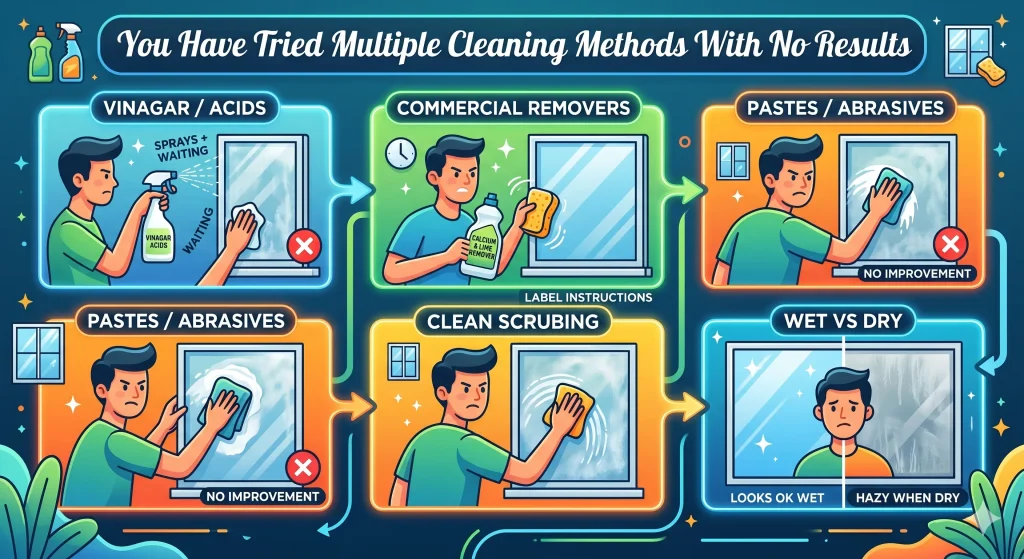
The most obvious sign that DIY cleaning has reached its limit is simple: you have tried the recommended approaches more than once, and the windows still look the same.
What this situation looks like:
- You have applied white vinegar or a diluted acid cleaner and let it sit for the recommended amount of time, with no visible improvement
- You have used a commercial calcium and lime remover according to the label instructions, and the haze remains
- You have tried a baking soda paste or similar gentle abrasive with no change to the stained areas
- The glass temporarily looks slightly better when wet, but returns to the same dull, hazy appearance once it dries
Understanding the full picture of what hard water does to glass, from initial formation to structural damage, also helps you have a more informed conversation with any service provider. Our breakdown of What Are Hard Water Stains? Signs, Causes, and What They Do to Glass gives you that foundational knowledge before you make any decisions.
The Glass Has a Permanent Haze That Does Not Change When Wet
This is one of the clearest diagnostic signs between surface staining and glass etching. The behavior of the glass when it is wet tells you a great deal about what you are actually dealing with.
How to do a quick wet test:
- Spray a small amount of clean water onto the stained area
- Observe how the glass looks while it is still wet
- Wipe it dry and observe how it looks again
If you want to avoid reaching this stage in the first place, learning How to Prevent Hard Water Stains on Windows Before They Set can help you protect your glass before permanent damage develops.
You Can Feel Texture Changes on the Glass Surface
Glass should feel smooth and uniform when you run your fingers across it. Any detectable change in texture is a sign that mineral damage has progressed beyond surface-level deposits.
What to feel for:
- A gritty or sandy texture in isolated areas where water regularly contacts the glass
- Rough patches concentrated near the bottom of the window, where water pools and dries repeatedly
- A pitted or uneven surface that feels different from the surrounding untreated glass
- Any area where the glass feels almost frosted or slightly rough to the touch
Staining Covers Large Areas or Multiple Windows
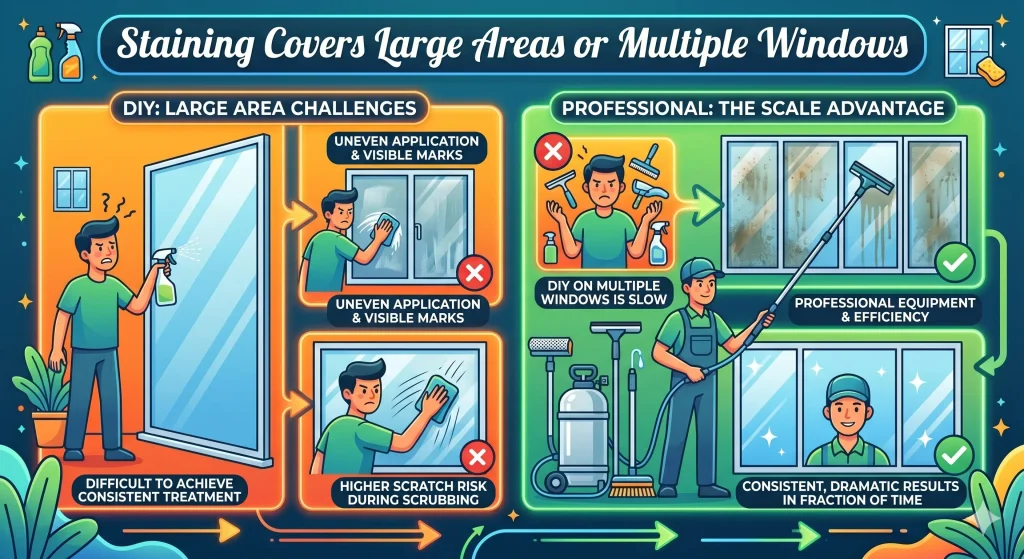
Scale matters when deciding between DIY and professional help. Treating one small stained area on a single window is a reasonable home project. Dealing with significant staining across several windows, or large areas of glass on patio doors and floor-to-ceiling windows, is a different situation entirely.
Reasons scale changes the equation:
- Large glass surfaces require consistent, even treatment that is difficult to achieve with household tools and spray bottles
- Uneven application of acidic cleaners on large glass panels can leave visible treatment marks or streaking
- DIY attempts on floor-to-ceiling or oversized glass carry a higher risk of introducing scratches during scrubbing
- Multiple heavily stained windows represent enough surface area that professional equipment produces dramatically better results in a fraction of the time
A professional cleaning and restoration service has the tools, techniques, and experience to treat large glass surfaces evenly and efficiently. For Fort Worth homeowners dealing with mineral buildup across an entire home’s worth of windows, a professional assessment and treatment is usually the more practical and cost-effective choice in the long run.
According to Bob Vila, large glass surfaces require specialized equipment and techniques that go far beyond what typical household cleaning tools can achieve.
The Damage Appears to Be Between the Glass Panes
This situation is different from surface staining and requires immediate professional attention. If you notice cloudiness, fogging, or streaking that appears to be inside a double or triple-pane window unit, between the glass layers rather than on the outer surface, the window seal has failed.
What a failed seal looks like:
- Condensation or fogging that appears between the panes and cannot be wiped away
- Streaks or hazy patterns that shift position over time or with temperature changes
- A permanent cloudy area in the center of the glass that is unaffected by cleaning the outer surface
- Visible moisture beads or droplets between the panes on cold mornings
The Whole Building Design Guide notes that glazing system failures, including seal deterioration, are among the most common causes of long-term window performance issues in residential and commercial buildings.

Your Windows Have Specialty Glass or Protective Coatings
Standard cleaning approaches that work fine on plain glass can cause serious damage to specialty glass types. If your windows have any of the following features, professional handling is the safer choice before attempting any treatment.
Glass types and coatings that require professional care:
- Low-E coatings: The thin metallic layer that improves energy efficiency is sensitive to acidic cleaners and abrasive scrubbing. Damage to a low-E coating cannot be repaired. The glass unit must be replaced.
- Tinted or solar control glass: Contains additives that can react unpredictably with certain cleaning chemicals, potentially causing discoloration or streaking that is permanent.
- Tempered glass with surface treatments: Some tempered glass units have factory-applied treatments that acidic cleaners can degrade over time.
- Laminated safety glass: The edges and seals of laminated glass are vulnerable to moisture intrusion if cleaning solutions are not applied and rinsed carefully.
You Are Preparing to Sell or Rent the Property
Window clarity is one of the first things prospective buyers and renters notice. Hazy, stained, or cloudy windows give an immediate negative impression of the property, even when everything else is in excellent condition. Professional window cleaning and restoration before a sale or rental listing is one of the highest-return investments a homeowner can make.
Why professional treatment makes sense before a sale:
- Professionally restored windows improve curb appeal and interior light quality immediately
- Clean, clear windows signal to buyers that the property has been well maintained
- Stained or damaged windows can raise concerns during home inspections and affect appraisal values
- The average cost of professional window cleaning and restoration is modest relative to its impact on perceived home value
What to Expect From a Professional Hard Water Stain Treatment
Many homeowners hesitate to call a professional because they are not sure what the process involves or what results to expect. Understanding the typical service helps you ask the right questions and make an informed decision.
What a professional hard water stain treatment typically includes:
- An initial assessment of the glass to determine whether the damage is surface-level or etched
- A test area treatment to confirm which products and techniques are appropriate for your specific glass type
- Application of professional-grade acid-based or chelating cleaning compounds that are stronger than retail products
- Mechanical polishing with specialized pads and compounds for etched surfaces, where chemical treatment alone is not sufficient
- A final inspection and rinse to confirm the result before the job is considered complete
- Recommendations for ongoing maintenance to prevent future buildup
How to Choose the Right Professional in Fort Worth
Not all window cleaning services have the experience or equipment to handle hard water stain restoration. Choosing the right professional makes a significant difference in the outcome.
What to look for when selecting a service:
- Specific experience with hard water stain removal and glass restoration, not just general window cleaning
- Knowledge of different glass types and coatings, including low-E and specialty glass
- Willingness to perform a test area before treating the entire window
- Clear communication about what results are realistic, given the current condition of the glass
- Verifiable local references or reviews from Fort Worth homeowners with similar staining issues
- Transparent pricing with no pressure to upsell services that are not necessary
And if you are still in the earlier stages where home treatment may still be effective, the step-by-step guide in How to Remove Hard Water Stains from Windows covers the full range of DIY options worth trying first.
Do Not Wait Until the Damage Is Too Deep to Fix
The longer hard water stains sit untreated, the fewer options you have and the higher the cost to address them. What begins as a surface cleaning issue can progress to etching that requires professional polishing, and etching that progresses far enough may require glass replacement entirely. Each stage is more expensive and more disruptive than the one before it.
Fort Worth homeowners are working against particularly challenging conditions, with high mineral content in the water supply and summer heat that accelerates every stage of the damage process. Calling a professional at the right moment is not admitting defeat. It is making a smart decision that protects the value of your home and the clarity of your windows before the window of opportunity to restore them closes.
At Atlas Solar-Tex, we understand how Fort Worth’s climate affects your windows from the inside out. If you are dealing with hard water stains that have gone beyond what DIY methods can handle, or if you want a professional opinion on the condition of your windows before investing in cleaning or restoration, contact us or give us a call. We are ready to help you take the right next step.
Frequently Asked Questions
Can a professional always fully restore glass with hard water etching?
Not always. Light to moderate etching can usually be polished out successfully. Deep etching that has penetrated significantly into the glass surface may not be fully reversible, and replacement may be the only option to fully restore clarity.
How long does a professional hard water stain treatment take for an average home?
A standard residential treatment covering multiple windows typically takes between two and four hours, depending on the number of windows and the severity of the deposits. Homes with significant etching or large glass panels may take longer.
Will professional cleaning prevent hard water stains from coming back?
Professional cleaning removes existing deposits but does not prevent new ones from forming. A good technician will recommend follow-up protective treatments and maintenance habits to slow the return of mineral buildup.
Is professional glass polishing safe for all window types?
Experienced technicians adjust their techniques and compounds based on the specific glass type. However, not all specialty glass can be polished safely, which is why a professional assessment before treatment is important.
How do I know if a window cleaning company is qualified to handle hard water restoration versus basic cleaning?
Ask whether they have specific experience with mineral etching and glass restoration, not just general cleaning. A qualified technician will be able to explain the difference between surface deposits and etching, and describe how they assess and treat each.
Can hard water stains on window screens be professionally treated as well?
Window screens with heavy mineral buildup are typically replaced rather than restored, as the cost of treating individual screen fibers is not practical. A professional can inspect your screens and advise on whether cleaning or replacement is the better choice.
What happens if I use the wrong DIY cleaner on specialty glass before calling a professional?
Depending on the product and glass type, the wrong cleaner can strip protective coatings, cause permanent streaking, or worsen etching. Always disclose what products you have already used when speaking with a professional so they can factor that into their assessment.
Are there situations where it is better to replace a window than to restore it professionally?
Yes. If the etching is very deep, if the window seal has failed, or if the glass has significant structural damage, replacement is often more cost-effective than repeated restoration attempts. A reputable technician will tell you honestly when replacement is the smarter investment.
How soon after professional treatment should I apply a water-repellent coating to protect the glass?
Most professionals recommend waiting 24 to 48 hours after a restoration treatment before applying any protective coating. This allows the glass surface to stabilize fully and ensures the coating bonds correctly to a clean, residue-free surface.